Showing posts with label raspberries. Show all posts

Friday, April 28, 2017

Grape and kiwi trellis

New kiwi trellis

I've been tardy in writing about my third big project for the year. We had put in a large trellis across a flat area toward the bottom of our hill about 12 years ago. The north section was intended to support two grapevines and a row of raspberries. The smaller south section was for three hardy kiwi. The plants all did great - in fact, too great. The grapes eventually shaded out the raspberries and I rplanted new raspberries further down the slope last year. It's time to revise and replace the whole trellis.

Looking south - old grape trellis in January
Looking north - kiwi end of the old trellis in January

For the hardy kiwi, I looked at a lot of trellis and arch options and decided on a circular moon gate trellis. I like the shape and thought it would provide a nice entryway to a path down the hillside. We installed it last month and just got the kiwi vines tied on. The kiwi that is furthest away is the male and grows more aggressively. I might need to add a connecting trellis to keep it under control - or prune it heavily each winter. All three of the kiwi were very slow to get established but now seem to produce more fruit if I cut them back.

New kiwi trellis
The grapes are fairly simple, we just need to move the posts and wires a few feet further west; they're east of the plants now because they were centered between the grapes and raspberries. That should pull the grape vines to the west and keep them from growing over the sunny hillside that is just below (east). The cross bars aren't needed anymore, it'll just be straight posts.

We've got the old trellis taken down but haven't put up the new posts yet. Mostly I'm just procrastinating on getting out the post hole digger because I remember what a pain the holes for original posts were to dig. I'm amused that the grapes are standing on their own with no support right now, after I cut them all the way back this winter. I did the same last winter and see above for how wild the vines grew in one year.

Looking north

I also need to cover the area under and around the grapes to kill off the weeds and then find groundcover plants. I have a few native wild ginger planted by the larger grape now, testing to see how that will do. This hillside gets full sun with no water (drip line for the fruit), but the grapes create a huge shady area in the summer.

Looking south - grapes pruned, trellis in progress

The new raspberries that I planted down the hill last spring are taking over already!

New row of raspberries, planted last year

Tuesday, April 19, 2016

Progress on the hillside, part 2

Great camas
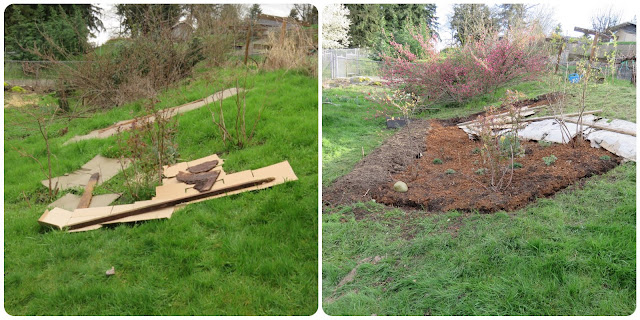
At this rate, I may end up with my whole backyard covered in cardboard. I finished covering the sunny half of the hillside and then just this week decided to cover the strip at the bottom too. The cardboard should mostly kill the grass in a couple of months and then I can dig out the old landscape fabric that's buried under here.

Feb. 21 and April 19

In my last update, I mentioned that I had planted aquilegia and transplanted wild strawberries next to where the raspberries would go. I've added a few more wild strawberries, dug up from other areas, and planted the raspberries. The bottom three are Autumn Britten and the top three are Caroline, both everbearing so I should have a few berries by late summer.

Raspberry

First aquilegia flower


I also put in four steps, they're dug into the hillside and stabilized with sand, but not as solid as a staircase would be. I think they'll be stable, but it's an experiment so I won't be upset if they need modification. I planted kinnikinnick between them, and will eventually add wild strawberries on that side - after the cardboard comes up.

Kinnikinnick, steps, raspberries, aquilegia and wild strawberries

Then I went to a plant sale and found native plants that I've been researching. The bottom of the hill is very soggy in the spring but dry and hot in the summer, so I want to try to grow a native meadow. This is blue eyed grass (Sisyrinchium idahoensis), common camas (Camassia quamash, 'Blue Melody'), great camas (Camassia leichtlinii) and thrift (Armeria maritima). The thrift will be moved further up the hill later. If I can find golden eyed grass, shooting star, taper tip onion, and hairbell, I'll plant them too and probably some type of sedge. 


Meadow plants

The crocosmia are starting to come up in between the raspberries, but something has been eating them. I bought two plants too so I can see what to look for, I was worried that I would accidentally pull them up when I'm weeding out grass shoots. That's my excuse anyway!

Crocosmia

Out of the scope of this project, but I'll mention it anyway: on the shady side of this hill, I planted two bleeding hearts and two mountain huckleberries. These are the native blue huckleberries and native bleeding hearts that some people call invasive, but I hope they will spread a lot. Eventually I want to dig out the weeds that have grown on this half of the hillside and fill it with native shade groundcover plants - under the flowering currant, Oregon grape and hazelnuts. That may be a project for next year, but I couldn't resist a few plants now.

Mountain huckleberry on top, another on bottom and bleeding hearts in the back

Friday, March 18, 2016

Progress on the hillside

February 21 and March 18, 2016

This area of the yard sure has changed in three weeks! I dug up all the weeds and grass around the blueberries and pulled out the groundcover fabric that was giving the grass roots something to grab onto. Last year, I had planted a lavender and a creeping phlox in the middle of the blueberries. Those were too close together so I split the creeping phlox into three pieces and moved it lower. I also planted three rock roses, three yarrow, and a mix of crocosmia corms. I've never grown crocomsia but love how they look.

The section down the hill had been covered in cardboard for about two months and I was amazed at how easy it was to dig out the grass. Cutting out the old groundcover fabric was the hardest part!

Raspberries will go down the middle, I'm just waiting for them to arrive. I transplanted a few groundcover strawberries on the south side and just added three aquilegia (columbine) today. Yes, impulse buys at the nursery - but I'm ok with that as long as they were on my list of plants that I'm interested in. I'm also growing aquilegia from seed so may have more to plant in here.
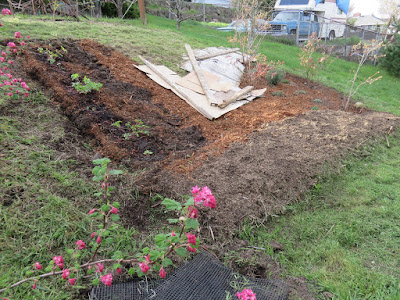

Looking up the hill, northwest

Next, I'm planning to get a few stepping stones and experiment with how to put them on the north side of the raspberries. The hill is steep and it'll be nice to have some steps to keep from sliding downhill when I'm picking raspberries.

The berm across the bottom is composed of cardboard, upside down grass clumps from all of the digging I did, a thick layer of miscellaneous plant bits from around the yard, and a layer of mulch. I scattered wildflower seeds on top of the mulch, to have a (hopefully) pretty temporary solution while everything decomposes and settles.

The middle section above that, between the raspberry row and the blueberries, is cardboard, upside down grass and bark mulch. I ran out of everything else to pile on it but wanted to use up the rest of the grass clumps.

There is, unfortunately, groundcover cloth somewhere under this, so I'll probably need to dig it out in the fall or next spring. I just didn't want to let all of the organic matter from the grass that I dug out of the other areas go to waste!
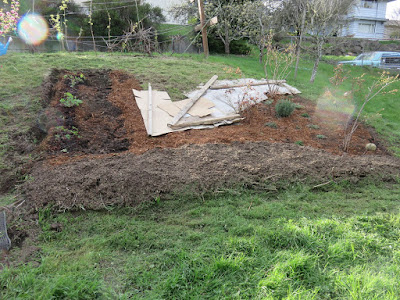
Temporary berm at bottom of hill

I put cardboard in place to kill off more grass, and I plan extend it all the way up to the grape trellis as soon as I can get more cardboard. The recycle box in Ikea's parking lot was sadly lacking boxes this week. I'm doing it this way rather than just piling on mulch because of the groundcover cloth that has to be dug out.

Once the grass is gone, I'm looking at a mixture of groundcover plants and perennials to cover the rest of the hillside, with a lot of bright colors: coreopsis, echinacea, yarrow, kinnickinnick, native thrift, and native grasses if I can find any that can handle the hot dry conditions. Don't be fooled by the nice black dirt in some of these pictures, there's a lot of clay and rocks underneath!
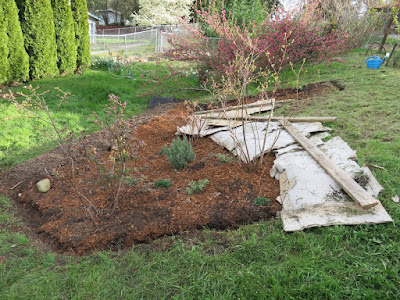
Blueberries with new companions

Friday, February 26, 2016

A hillside of work


Lower hillside, facing south
This north half of the lower hillside is my third area to focus on this year, along with the rose garden and the southeast corner (which is visible in the back of the above photo). Ignore the cardboard, it's a temporary attempt to keep the grass and weeds from growing too much before I have time to deal with them.

The first spring after we bought the house, we planted a multitude of fruit and berries: four blueberries on the hillside, two dwarf apples, raspberries on the near side of the trellis, two grapes behind them, and three hardy kiwi on the far end of the trellis. Thirteen years later, the grapes grow amazingly well and completely shade out the raspberries. We need to re-do the trellis (maybe this year, maybe not) for the grapes, and take out the original raspberries - which have probably reached the end of their productive lifespan anyway.

Instead, I want to plant a shorter row of raspberries down the hillside, with wire on metal fence posts to support them. That'll be less solid than the current trellis, but the everbearing type that I like really don't need much support. I also want some type of stepping stones up the hill on either side of the raspberries, because the slope is steeper than it looks and it's easy to slip.

Lower hillside, facing west
The blueberries have grown fairly well, but they'd be happier if I keep the grass and creeping buttercup out. I dug out a big circle of grass around all four bushes last year, and a lot of it has come right back again. I've been researching companion plants for blueberries and there are a lot of options as long as I keep them from directly competing with the blueberries's shallow roots.

All of the grass from the blueberries to the bushes on the south half of the slope (flowering currant, Oregon grape and hazelnuts) needs to come out. It's too hard to mow across the slope, and will be even harder when the new raspberries are planted. This side of the hill gets full sun for most of the day, so I've been looking at some of the native carex grasses. Maybe sedum also, and plumbago might look good with the blueberry stems in the fall. I'm still looking for ideas of what would grow well with full sun and no extra water. I have a drip line on the berries, but I don't plan to water anything else after the new plants are established.

The bottom of the hillside gets very wet in the winter and I'm thinking about planting Siberian irises along the edge of the slope. But not sure if that will be in this project or not!